CPQ stands for Configure, Price, Quote. A product configurator lets sales reps, dealers or customers compose a valid product, calculates the price live, and generates the quote and bill of materials. But not all configurators are equal, the difference is in the technology underneath.
Sell more variants without managing more articles
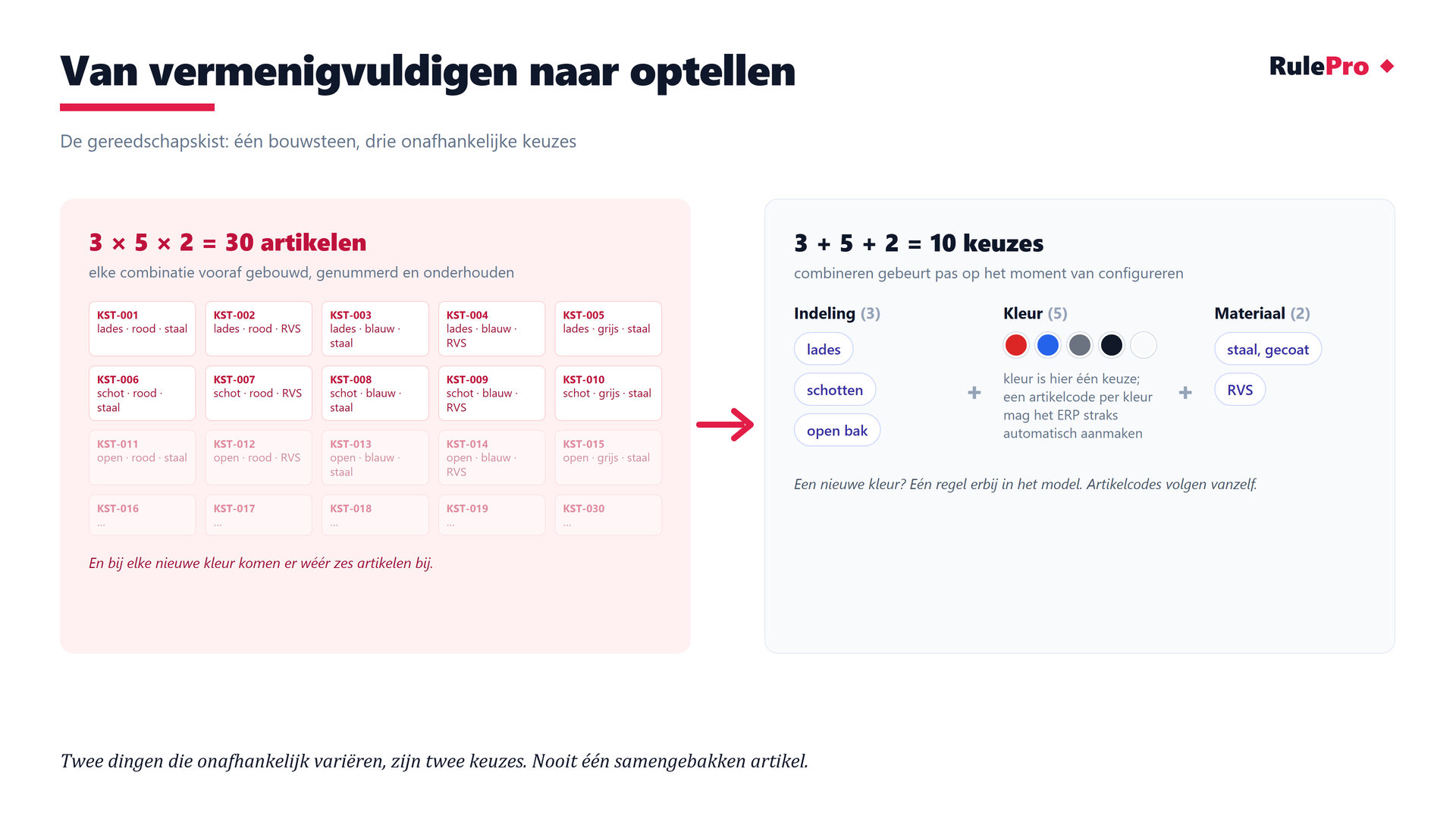
Imagine a toolbox with three layouts, five colours and two materials. You do not need to maintain thirty separate products. You capture each choice once. The sales rep combines them while configuring. Add a colour and you add it once.
Do not just block a choice, explain it
A configurator should do more than block an option. With SoftLock mode, a conflicting choice remains visible and open for discussion. RulePro shows why the choice does not fit. Where possible, it suggests other answers that make the choice fit after all. The proposal is applied only after confirmation. Under the hood, a constraint solver checks all product rules at once. That lets sales answer questions in a logical order and create a quote with one click from a completed configuration.
The system knows the origin of every value. Did the customer choose it, did a rule force it, or did the solver fill it in? So you can explain every value, to the customer and to the auditor.
Quotes stay linked to their version
A quote stays linked to the version it was created with. If you later change rules, prices or screens, an open quote does not change with them. That prevents spreadsheet versions, prices and product rules from becoming mixed up. Modules version independently, and the register shows in advance who a change affects.
Product rules and prices stay separate
Your team decides what is technically possible. Your commercial team decides what it costs. Price lists sit apart from the product model and can coexist for your own sales, dealers and customer segments. A price increase needs no model change. If a price is missing, your team sees it immediately. RulePro does not quietly use an outdated amount.
One product model for multiple sales channels
One product model can support your own sales, dealers and a web configurator. Sales quotes faster. Dealers work with their own price agreements and see only options that fit the chosen version. Website visitors can send a configuration with their enquiry.
From product knowledge to a manageable model
Capture choices, variants and product rules in a structured way. RulePro makes that knowledge usable for sales, engineering and production, even as the number of combinations grows.
What is inside RulePro
RulePro is more than a questionnaire with a price underneath. This is the overview in one picture. The explanation per part lives on the features page.